100 Amp to 200 Amp Electrical Panel Upgrade in Ontario
 Written by Panel Quotes |
November 2026
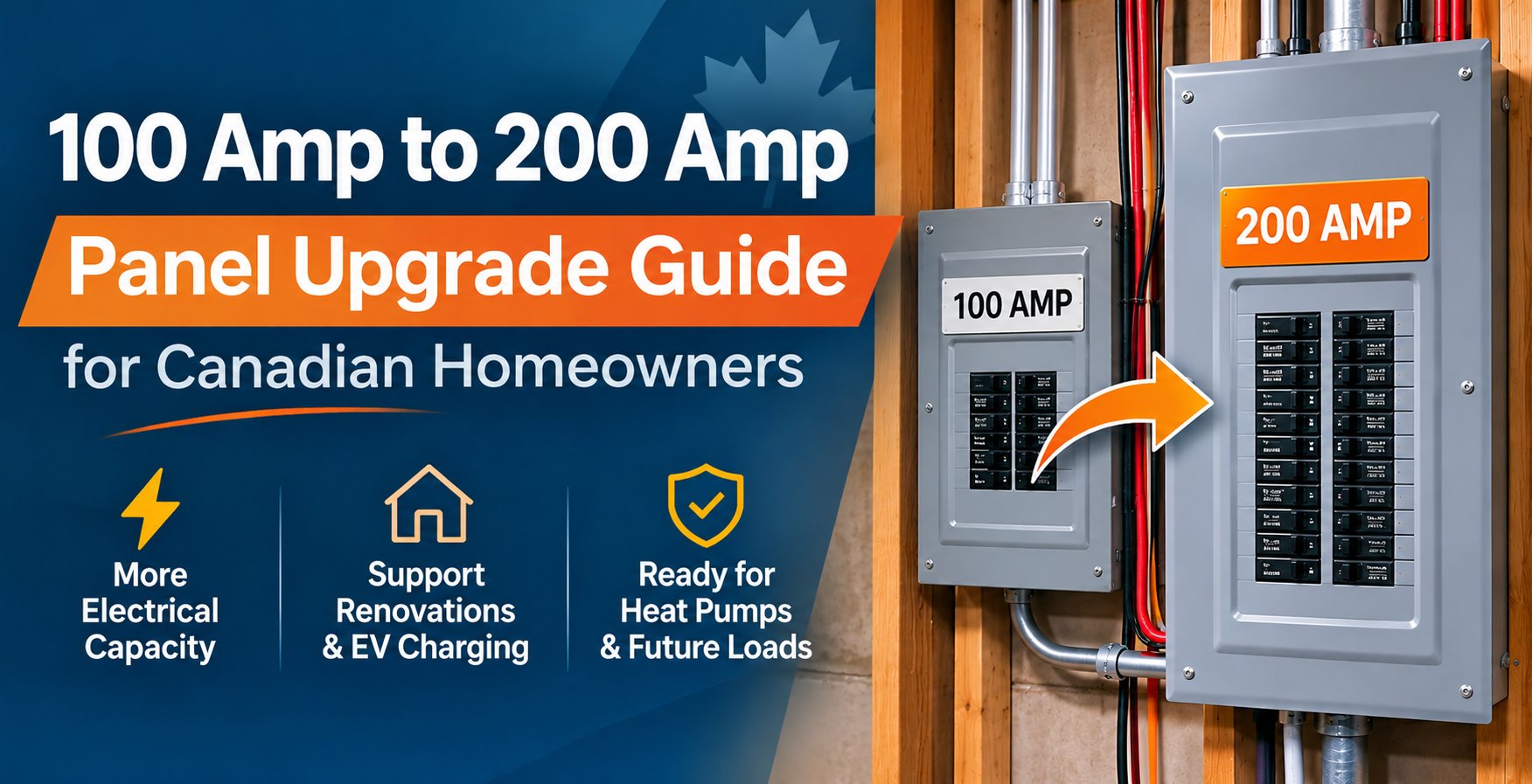
A 100amp to 200amp electric panel upgrade gives a Canadian home more room for modern electrical demand, from heat pumps and EV chargers to induction ranges, hot tubs, and finished basements. It is not automatically necessary for every property, but it can improve capacity, safety, and future flexibility when the existing service is nearing its limits.
Here is how 100-amp and 200-amp panels compare, the signs an upgrade makes sense, and what changing your electrical service involves.
⚡ Key takeaways
- Choose service size through a formal load calculation, not home size or panel breaker space alone.
- 200-amp service supports high-demand additions like EV chargers, heat pumps, electric ranges, hot tubs, and workshops.
- An upgrade may require new meter equipment, service conductors, grounding, utility coordination, permits, and inspections.
- A 100-amp service can remain adequate for modest loads if a licensed electrician confirms capacity.
- Ontario service upgrades typically require ESA notification; municipal permits may apply depending on project scope.
100amp panel vs 200amp panel
The right electrical panel size depends less on a home's square footage than on how it uses power now and what it may need to support next. A 100-amp panel can be adequate for a smaller home with gas heat, gas cooking, modest air-conditioning needs, and few major electric appliances. A 200-amp panel provides substantially more capacity for modern all-electric equipment, including heat pumps, electric ranges, dryers, hot tubs, workshop circuits, and EV chargers.
- A 100-amp panel may suit: Smaller homes with gas appliances and limited high-demand electrical equipment.
- A 200-amp panel may suit: Homes adding heat pumps, EV chargers, electric cooking, workshop circuits, or other large loads.
- The key factor: A load calculation confirms whether the existing service can safely support present and planned demand.
The important distinction is not simply the number printed on the panel door. You must evaluate the service size, main breaker, meter equipment, feeder conductors, and utility connection together. A home may have a panel with physical space for additional breakers but still lack the electrical capacity to safely add large new loads. Conversely, an older 100-amp service may meet present-day needs perfectly well if a formal load calculation supports it.
For homeowners planning renovations or electrification, a 200-amp service is often the more flexible long-term choice. It can leave room for future circuits without relying on crowded panels, tandem breakers, or repeated upgrades. That said, upgrading from 100 amps to 200 amps can involve utility coordination, new service equipment, grounding updates, permits, and inspection requirements, so the scope varies widely by property and local code.
A licensed electrician can perform a load calculation based on the home’s actual appliances, heating and cooling equipment, and planned additions. That assessment is the practical way to decide whether a 100-amp panel remains sufficient or whether a 200-amp upgrade is a worthwhile investment.
Panel Size Decision Checklist
- List current major loads: HVAC, range, dryer, water heater, hot tub, workshop equipment, and EV charging.
- Consider a 100-amp service for smaller homes with gas appliances and limited high-demand electrical equipment.
- Choose 200 amps for added flexibility with heat pumps, electric cooking, multiple appliances, or future electrification plans.
- Confirm service capacity, main breaker, meter equipment, feeders, and utility connection, not just open breaker spaces.
- Request a licensed electrician’s formal load calculation using actual equipment and planned additions.
- Budget for permits, inspection, grounding updates, utility coordination, and possible service-equipment replacement during an upgrade.
Who needs to upgrade from 100amp to 200amp
A 100-amp electrical service can still suit a compact home with modest appliance use, but it leaves little room for the way many households live now. If your panel is full, breakers trip when several appliances run at once, or you are planning major electrification, a 200-amp upgrade is often the sensible next step. It provides the capacity for modern loads while giving an electrician a safer, more orderly base for future work.
Homes adding central air conditioning, an electric range, heat pump, hot tub, workshop equipment, solar batteries, or an EV charger are common candidates. The same is true for older properties with fuse boxes, damaged panels, recalled equipment, or service entrances that no longer meet current standards. A licensed electrician should perform a formal load calculation before you decide; your home's size alone doesn't determine the service you need.
100amp to 200amp electric panel upgrade: what it changes
A 100amp to 200amp electric panel upgrade does more than replace the metal box on the wall. It increases the home’s available electrical service, the total amount of power that can be delivered safely from the utility connection to the electrical panel, then distributed through individual circuits. For many older houses, a 100-amp service was appropriate when electrical loads were limited to lighting, kitchen appliances, and perhaps a modest air-conditioning system.
Today’s homes often carry far more demand: central heating equipment, electric ranges, heat pumps, EV chargers, workshop tools, hot tubs, induction cooking, and the expectation that every room can support modern technology. A 200 amp service gives the electrical system more capacity to handle those loads without continually pushing the panel toward its limits.
The work may include a new 200 amp panel, updated meter equipment, larger service conductors, a new main breaker, improved grounding and bonding, and coordination with the utility provider. It can also be an opportunity to correct crowded wiring, mislabeled circuits, outdated breakers, or additions made over decades of ownership. Importantly, upgrading service size does not automatically mean you must replace every circuit in the house, nor does it make existing equipment use more electricity. It means the electric infrastructure can safely support present needs and planned upgrades. A qualified electrician determines the right scope through a load calculation, which looks at the home’s square footage, appliances, heating and cooling, and anticipated additions, not simply the number of devices plugged in.
For a commercial property, the same principle applies, though the calculation and equipment requirements can be considerably more complex. The practical result is a panel with more usable space and a stronger base for future electrical work, whether that means adding a dedicated circuit for an EV charger, converting gas heating to electric, finishing a basement, or renovating a kitchen.
In areas with older housing stock, a service upgrade can also be essential before installing high-demand equipment that a 100 amp panel was never designed to serve. The best upgrade is sized for how the home actually operates, with enough capacity for thoughtful growth, rather than an oversized solution based on assumptions alone.
What a 200-Amp Upgrade Changes
- Raises available electrical capacity for modern appliances, heating, cooling, and high-demand equipment.
- May include a new panel, main breaker, meter equipment, service conductors, grounding, and bonding.
- Creates room for dedicated circuits, including EV chargers, heat pumps, induction ranges, and workshop tools.
- Does not automatically require replacing every existing branch circuit throughout the house.
- Does not cause equipment to use more electricity; it increases the system’s safe delivery capacity.
- Lets an electrician correct crowded wiring, outdated breakers, inaccurate labels, and past additions.
- Requires a load calculation based on the home’s size, installed equipment, and plans.
Load calculation and panel upgrades: choosing the right amp upgrade
An amp upgrade should start with a clear picture of how a home actually uses power, not the assumption that a larger number is automatically better. A professional load calculation reviews the electrical load created by the home’s major systems and everyday demands: heating and cooling equipment, electric ranges, dryers, water heaters, EV charging, hot tubs, workshop circuits, lighting, appliances, and planned additions. It also considers the capacity already available at the service, the condition of the existing panel, and whether the home’s wiring and grounding system can support modern use.
This process is especially important in older homes, where a panel may have open breaker spaces yet limited overall capacity. Conversely, a newer home may only need targeted upgrades, such as a dedicated circuit for an EV charger or an updated subpanel, rather than a complete service replacement. The goal is to choose an amp upgrade that supports current needs while leaving sensible room for the home's next phase, without paying for capacity that will never be used.
Panel upgrades are sometimes presented as a quick swap: remove the old box, install a larger one, and move the circuits over. In practice, the right scope can involve far more. Depending on the findings, the work may include a new meter base, service entrance conductors, grounding and bonding improvements, breaker replacement, utility coordination, permits, inspections, or repairs to aging wiring. These details affect both safety and cost, so estimates should explain what is included beyond the panel itself.
A licensed electrical contractor can calculate demand according to applicable code, identify constraints at the service equipment, and outline practical options. These services should include a clear review of plans before recommending a size: a kitchen remodel, heat-pump conversion, solar installation, accessory dwelling unit, or electric vehicle can materially change the load profile. Experienced electricians will also ask about those plans before recommending a size. Their services should translate technical findings into a straightforward recommendation, including why a 100-, 150-, 200-, or higher-amp service makes sense for the property.
The best upgrade is not simply the largest panel on the market. It is a well-designed electrical system with adequate capacity, properly rated equipment, safe connections, and a documented path for future improvements. A careful load calculation gives homeowners the confidence to invest once, choose wisely, and avoid discovering too late that a seemingly simple upgrade left the home short on power.
What a Panel Upgrade Assessment May Include
| Assessment area | What is reviewed | Why it matters |
|---|---|---|
| Household demand | Loads from heating and cooling equipment, ranges, dryers, water heaters, EV charging, hot tubs, workshop circuits, lighting, appliances, and planned additions. | Determines the capacity needed for current use without purchasing service capacity the home will not use. |
| Existing service capacity | The capacity already available at the electrical service and constraints at the service equipment. | Open breaker spaces do not necessarily mean the home has sufficient overall capacity, particularly in older homes. |
| Panel condition | The condition of the existing panel and whether targeted work, such as an updated subpanel or dedicated circuit, may be appropriate. | Helps determine whether a complete service replacement is needed or a more limited upgrade can meet the home's needs. |
| Wiring and grounding | Whether the home's wiring and grounding system are suited to modern electrical use, along with any aging-wiring concerns. | May require grounding and bonding improvements or wiring repairs to provide safe connections and properly rated equipment. |
| Future plans | Potential kitchen remodels, heat-pump conversions, solar installation, an accessory dwelling unit, or an electric vehicle. | Future changes can materially alter the load profile and influence whether a 100-, 150-, 200-, or higher-amp service makes sense. |
| Project requirements | Possible new meter base, service entrance conductors, breaker replacement, utility coordination, permits, and inspections. | These items can extend the work beyond the panel enclosure and affect both safety and cost. |
Smart Panel Upgrade Checklist
- Document major loads, including HVAC, cooking, laundry, water heating, EV charging, hot tubs, workshops, and planned additions.
- Request a code-based load calculation before selecting 100-, 150-, 200-, or higher-amp service capacity.
- Evaluate existing service equipment, panel condition, available capacity, wiring age, grounding, and bonding.
- Ask whether targeted work, such as an EV circuit or subpanel, can meet needs without replacing the entire service.
- Discuss future projects early, including heat pumps, solar, kitchen remodels, accessory dwelling units, and additional appliances.
- Review estimates for meter bases, service conductors, breakers, permits, inspections, utility coordination, and wiring repairs.
- Choose properly rated equipment with practical expansion room, avoiding unnecessary capacity that adds cost without benefit.
Building permit, electrical service and upgrade FAQs
An electrical service upgrade is not a single approval; it is a coordinated project involving the utility, the Electrical Safety Authority (ESA), and sometimes your local municipality. In Ontario, the ESA inspection process is central to work on a home’s electrical service. A licensed electrical contractor can inspect the existing panel, load demand, meter equipment, and grounding, then explain which filings and inspections apply before work begins.
Do you need a building permit? It depends on the scope and location of the work. Replacing or enlarging electrical equipment alone may not always require a municipal building permit. Still, changes to the service entrance, exterior mast, structural openings, detached structures, or related renovations can trigger local requirements. Your contractor should confirm the rules with the municipality rather than relying on a general assumption. The ESA notification, often casually called an electrical permit, is separate from a municipal permit and is typically required for a service upgrade.
Can a homeowner arrange the permit? In some circumstances, homeowners may file an ESA notification for electrical work at their own residence. For a service upgrade, however, hiring a licensed electrical contractor is the more prudent route. Service work involves utility coordination, code-compliant equipment selection, inspection timing, and a safe transfer from the old service to the new one. The contractor can also identify issues that may affect approval, for example, inadequate clearance, obsolete meter equipment, damaged service conductors, or an undersized panel.
What does it cost? The final cost varies with the amperage, the condition of the existing electrical service, the distance to the panel, utility requirements, and whether the project includes new circuits, a panel replacement, or capacity for an EV charger, heat pump, or suite. A straightforward 100-amp to 200-amp service upgrade differs substantially from a project requiring a new mast, trenching, meter relocation or upgrades to the utility connection. Obtain a detailed quote that distinguishes contractor labor, equipment, ESA fees, utility charges, and any municipal permit costs.
And if you are wondering whether more capacity is possible: yes, you can absolutely upgrade when the home, utility infrastructure, and installation plan support it. The right starting point is a formal load calculation and site assessment, not a panel-size guess. That approach gives you a clear path to a safer, code-compliant service with room for the way you plan to use the home.